Earlier this week we wrapped up our Earth Day inspired contest. From telescopes, to robots and treasure maps, we loved seeing how creative your Beans were with just a plain old cardboard box!
Creative and imaginative play such as this is so beneficial for our children. Through this type of play, our Beans are able to practice social and emotional skills, problem solving, skills in cooperation if playing with another, learn self-reliance, and so much more!
Getting creative with a plain old cardboard box proves that encouraging our children to practice this type of play doesn't have to be complicated. Try putting together a play area or prop trunk filled with old things you have laying around the house! Old shoes, hats, costumes, fabric/blankets, boxes/crates, stuffed animals or dolls are all perfect role-play toys and make for great imaginative play!
This weekend we hope you continue encouraging creative or imaginative play with your Beans! We love seeing what type of play you and your Beans are up to, so don't forget to post pictures to our Facebook page or tag us on Instagram.
For more imaginative play inspiration, click HERE.
First off, let me explain why I want to share our community of amazing educators with you, and why I am a stand for our series “PLAY-ducation”.
We are suffering a Play Deficit. It isn’t hypothetical, it isn’t some social media farce gone wrong. It is true. Canada received a failing grade in the area of play. A big F! What would you do if your bean came home with an F on their report card, you would certainly pay attention. So we are! Play will not die off overnight, it will be a slow process and in generations to come, there will be no such thing of Free, Unstructured Play. And generations will suffer. We will lose the vital skills that we need to grow into healthy, well-adjusted communicative adults.
Insert our Play Series. Different topics, amazing speakers, a night out to grow, learn and feel supported in your family values.
This week we had the AMAZING Andrea Chatwin, our resident Play Maven and Certified Childhood Development Specialist come and talk about Tweens. I was particularly excited about this topic because I have a tween. I see how my five year old plays unleashed and perfectly without any restrictions, but I notice as my first born, a once unleashed little girl now turned tween, is still young at heart but craving to be mature and grown up.
So we created a presentation “Tweens Need to Play Too” and as always Andrea Chatwin NEVER DISAPPOINTS. Although hard to articulate the impact of what I learned, I will share a few key points:
Tweens need to play in order to develop into confident and competent young people. Their need for self directed, unstructured free play remains consistent even as they enter middle to late childhood, and moreover Neuroscience is telling us that children need to play for optimal brain development to occur!
Artificial Mastery – electronics easily and quickly give the child/tween the feeling of “I did something well”. Making actual, real life mastery some what boring.
Immediate Gratification – the user feels relief and/or feels better faster than it takes when one goes out to play.
Dissociative State– “I am no longer available emotionally in this situation”. children/tweens can shut out the outside world, they don’t have to feel anything or be connected with their inner worlds. They can be emotionally blank, yet still get immediate gratification.
Coming down from the technology high:
Mood differences post electronic play; Limited patience or impulse control; Difficulty focusing or attending to tasks; Impact on parent child relationship
Responding to your child/tweens behavior:
Step 1 – Empathy, Empathy, Empathy. Express to your child/tween that you fully understand what their experience is right now and why their request is so important (ie. I want to watch more tv). Get alignment.
Step 2 – Set your limit clearly and firmly (ie. tv is not for today).
Step 3 – Give your child/tween choices to return some control back to them. Refocus the issue on to something they do have control over (Ie. no tv before school, but when you come home you can decide if you want to watch 1 hour after school or after dinner).
How to Play with Your Tweens:
Offer joint attention. Focus and value something just as much as they do. Join their experience. Find what lights their eyes, what causes them to be interested. If only for 30 minutes a week be with them in whatever capacity they desire.
Playing with a younger child helps your tween to engage in healthy play activities without the concern that it is too babyish.
Keep toys accessible. Even when kids/tweens claim that they are finished with “toys”, if they are accessible they will likely gravitate towards them in quiet times.
Encourage natural play. Kids need to be outside, whether this is at a local park or in your backyards
Play together as a family. Indoor games, outdoor activities, sports, crafting.
Join us Wednesday, October 29th for the next talk in our PLAY-ducation Series, "Raising Children in a Digital World" with Dr. Deborah MacNamara. Admission is by donation. All proceeds will be donated to Playground Builders. Please SAVE YOUR SEAT and RSVP to play@peekaboobeans.com. In love and play,
This Friday, we are hosting a Pop Up Playdate at the brand new Terra Nova Park in Richmond. We have heard from many MANY of our VIPBs that this park is.... AMAZING! We hear this new 1 million dollar innovative 1-hectare rural park is equipped with many custom-made features like a tandem zipline, a farm inspired water and sand play area, a log jam, a 10-metre treehouse, and an aerial rope walkway. Obviously this park has been built for some SERIOUS PLAY!!
So come going us at 10am tomorrow for some playtime and Mommy social time. Of course we won't be forgetting the Starbucks coffee!
Also, Peekaboo Beans Marketing and Video Team will be on hand to film the Playdate for an upcoming promotional video. So if you would like to see our head office peeps in action, be sure to show up by 10am.... you never know, you and your Beans might get the chance to be showcased in our exciting home-grown Pop Up Playdate video. Keep on playing!
"When I started Peekaboo Beans, it was because I believed that our children should have better options in clothing. Clothing is so much more than just what we put on our bodies. It is what makes us feel good about ourselves, it helps us define our personalities and contributes to our uniqueness, it makes us feel completely comfortable, or completely uncomfortable (if in the wrong clothing)..."
- Traci Costa
Peekaboo Beans, Director of Play
Clothing is so much more than simply what we put on our bodies. It is what makes us feel good about ourselves, helps us define our personalities, and contributes to our uniqueness. It makes us feel completely comfortable, or completely uncomfortable (if in the wrong clothing)...
Peekaboo Beans is here to spread the message for beans across the land: "let me play.” Stats show that if given the chance, children would choose to play outside with their parents and friends 9 out of ten times, yet the staggering statistics show that children are spending on average 8 hours a day in front of media devices.
Our mission is to provide the ingredients for a playful life. Children should be able to play free from stiff, restricting clothes. Doesn't your kid deserve to look good without being held back?
We have created a new platform of videos showing how ridiculous it looks doing an activity in the wrong clothing. As adults, we know what is appropriate to wear for different activities, so why would we not do the same for our children? Sometimes you just have to ask - would you play in that?
Clothing is so much more than simply what we put on our
bodies. It is what makes us feel good about ourselves, helps us define our
personalities, and contributes to our uniqueness. It makes us feel completely comfortable, or
completely uncomfortable (if in the wrong clothing)...
Peekaboo Beans is here to spread the message for beans
across the land: "let me play.” Stats show that if given the chance, children
would choose to play outside with their parents and friends 9 out of ten times,
yet the staggering statistics show that children are spending on average 8
hours a day in front of media devices.
Our mission is to provide the ingredients for a playful
life. Children should be able to play free
from stiff, restricting clothes. Doesn't
your kid deserve to look good without being held back?
We have created a new platform of videos showing how
ridiculous it looks doing an activity in the wrong clothing. As adults, we know what is appropriate to
wear for different activities, so why would we not do the same for our
children? Sometimes you just have to ask
- would you play in that?
Playing as a Form of Therapy
D.W. Winnicott, a psychoanalyst of the past century, suggested that playing was the key to emotional and psychological well-being. He devised a mode of therapy with children known as “play therapy.”
The child leads the therapist in some kind of play activity until the child can trust the therapist enough and open up . However, the child must initiate the playing in a spontaneous way.
Why? Because you can’t force playing, just like you can’t force creativity.
The Way That Children Play
Ever watch children play? They’re constantly creating and changing rules for games they invent.
And when the rules don’t work, they re-invent them. For children, a stick could become a magic wand, a sword and a lightsaber all in one afternoon. Kids don’t limit it to just being a stick because someone told them it’s a stick. Heck, they’ll use the stick to make a circle in the dirt and tell you it’s their secret base that you’re not allowed into. Then, five minutes later (when they get bored), you’re suddenly allowed in. They keep adjusting the ‘rules’ of playing until they work.
Changing the Rules of Teaching
A few years ago, when I taught high school, I struggled to come up with a final assignment for my students. When I failed to find one that fit with my students, I decided to change the rules.
Instead of a typical writing assignment based on class readings, I asked my students to create the ‘ultimate super villain’ and present it in two different ways. The only guideline? The villain’s attributes had to be based on characters we studied that semester. That’s it.
The result was a production of their best creative work all semester. I was so blown away that for the final exam, instead of a “traditional reading,” I asked my students to read a Lifehack article and provide a response. It was the most enjoyable marking experience I’ve had. I threw out the rules of teaching and had fun. And the results were spectacular. All it took was a willingness to let my ideas go wild .
What does This Teach Us ?
Our best work comes when we’re having fun with what we do. As adults, we get stuck in our heads, limiting ourselves to set rules and guidelines. Sometimes, you have to throw away the rules and just let things flow. Be spontaneous and do something different.Be yourself in your work. As a student, I hindered my creativity out of a fear to put my own voice in my essays. I depended on the voice of others because it felt ‘proper.’ But when I wrote with my voice, essays became fun to write, and sounded infinitely better .
The second you stop following the prescribed rules, you’ll uncover creativity you never knew you had. According to Winnicott, only in creativity do we find ourselves.
Don’t lock yourself within a set of self-imposed rules.
Act like a kid: when the game doesn't work, change the rules until it does.
Now go play… and tell me how it turns out for you.
Watch our brand new Play Revolution Video and help spread the word on the Importance of PLAY!
Peekaboo Beans is a stand for free unstructured play so our children can develop into happy healthy beans!
A newborn baby cannot hold or even swipe at an iPad, but Fisher-Price is providing a way to keep infants glued to the device.
The Newborn-to-Toddler Apptivity Seat for the iPad allows parents to strap a baby to the reclining bouncy chair and slip a tablet into an attached case that hovers several inches above the infant’s face.
The seat is chafing parents and child advocates who say the introduction of screen technology so early is harmful to the health and development of babies. Fisher-Price’s seat seems to hit a new low, they say, but other retailers also are promoting holiday gifts that integrate tech into baby gear, even a potty-training seat with an iPad stand.
Fisher-Price’s iPad seat is the “ultimate electronic babysitter, whose very existence suggests that it’s fine to leave babies as young as newborns all alone and with an iPad inches from their face,” said Susan Linn, director of the Campaign for a Commercial-Free Childhood (CCFC), a child advocacy group.
The group on Tuesday launched a letter-writing campaign aimed at trying to persuade Mattel, the parent company of Fisher-Price, to stop selling the seat.
“Fisher-Price should stay true to its mission to foster learning and development by creating products for infants that promote, rather than undermine, interaction with caregivers,” Linn said.
Victor Strasburger, a doctor and professor of pediatrics at the University of New Mexico School of Medicine, said attaching iPads to babies’ seats is “a terrible idea.”
“Does anyone out there think that kids need more screen time?” Strasburger asked. “There is no need to hurry to expose kids to new technology, certainly not babies — or newborns.”
Mattel did not respond to a request for comment on the iPad seat, but the company promotes the seat as a way to entertain and foster a baby’s physical development. Fisher-Price describes the product on its Web site as “a grow-with-me seat for baby that’s soothing, entertaining, and has a touch of technology, too.”
Mattel is already under pressure by the CCFC and other advocacy groups that have complained to the Federal Trade Commission that Fisher-Price’s mobile Apptivity suite of apps deceives consumers with promised educational benefits despite little research having been done to prove that online sites can help babies’ brain development.
Mattel encourages parents to download its iPad Apptivity apps, which it says “feature soft, soothing sounds and nature scenes, black-and-white images and high-contrast patterns that help develop eye-tracking skills.”
Other retailers have created similar products aimed at putting screen devices in front of children at the earliest ages.
CTA Digital’s 2-in-1 iPotty With Activity Seat for iPad allows babies and toddlers to tap away at a tablet positioned in front of a plastic potty-training bowl. The company, which makes accessories for tablets and video games, has a commissioned study on its site that touts the use of technology in child development, including potty training.
“Many young children already love playing with their parents’ iPad, and now they can safely do so with the iPotty,” CTA Digital says on its Web site. “It provides a fun and comfortable place to sit, while learning how to safely use the potty, playing apps, reading books or watching video clips.”
The Brooklyn-based company said that despite some criticism, it has seen a boom in sales of the iPotty. The toilet trainer was first introduced a year ago and has become the company’s second-most popular product aimed at babies and children.
“Most families have technology in the home, and the reality is that kids are exposed already, and parents are trying to find the best ways to adapt into their lives the technology in a way that is safe and thoughtful,” said Lois Eiler, marketing associate for CTA Digital. The company also sells an iRocking play seat with an attached feeding tray that can be replaced as an iPad holder.
The slew of new baby-tech products has drawn criticism from parents blasting CTA and Fisher-Price in Amazon.com’s customer-review sections. Fisher-Price’s seat had more than 100 reviews, many negative.
“If you want to damage your child’s development, buy this chair,” one reviewer wrote. “Children of a very young age are genetically programmed to respond positively to interacting with PEOPLE. Even if they are just watching the world go by. This is a horrible gadget.”
The American Academy of Pediatrics discourages screen time for children younger than 2, including mobile technology. As companies rush to integrate technology into toys, baby gear and classrooms, doctors and child advocates say children are immersed more than ever in a world of screens. That constant access to games, television and the Internet may be taking away from family time, exercise and discovery in the physical world, critics say.
___________________________________________
What are your thoughts? We want to hear from you. Please post your comments below and let us know what your experience with Tech Toys for babies and toddlers has been. Are you for or against? Do you limit your Bean's usage of electronics? Or do you need to use gadgets to help "babysit" your Bean while you're briefly attending to other needs? Would you bring a product like the Fisher Price Apptivity Seat or the iPotty into your home? Share with us... our Bean Brains want to know!
At Peekaboo Beans, we are all about PLAY and the importance of it. So in order for you to take some time and remember to still have fun through all the hustle and bustle of the holiday season, we have created this playful Holiday Advent Calendar for you to print, create and share with your Beans.
We have included some simple activities such as making paper snowflakes, and baking cookies to more playful creations like indoor snowball fights and balloon paddle ball. We love to keep the play alive for you and your Beans, so take advantage by creating some playful memories for your family this holiday season.
Click HERE to download your printable copy of our 24 days of PLAY Advent Calendar.
Originally posted by the Globe and Mail, November 16th. The brand-new subdivisions of Toronto roll on and on into the cornfields, a new one every month. I drive by them all the time. This is where young families live. But the streets and sidewalks are eerily quiet. You hardly ever see a child. No kids riding bikes. No kids playing shinny. No kids running wild in packs until their moms call them in for supper. It’s as if the kids have vanished. Where are they? Indoors, doing homework or playing Nintendo. In all-day kindergarten or regulated daycare. Instead of pickup street hockey, they’re playing organized sports with regularly scheduled practices and games, supervised by grown-ups. They’re at Kumon or dance or art, or swimming or tae kwon do. The children of the upper middle class are busy, busy, busy, with schedules that would rival that of any CEO. It never stops. In high school, they start building their résumés for university. Community service? Check. Sports? Check. Squeeze in a part-time job. If they have some athletic talent, their parents will start investing serious time and money in it. By 18, they are seasoned veterans of the programmed life. No wonder so many of them are helpless. All their lives, somebody else has told them what to do and where to be. Once they’re on their own, they fall apart. Universities report record levels of stress among their students. Professors complain that for their male students in particular, 19 is the new 17. The kids have never learned to stand on their own two feet. Could it be that we are doing them more harm than good?
David Whitebread thinks so. He’s a psychologist at Cambridge University who specializes in the early years. He and 120 other experts have launched a campaign to get the British government to roll back early education, which begins at 5. Starting children too early on formal learning, he maintains, can cause “profound damage,” including stress and mental-health problems. Until age 7, what children really need is … play. “Play is a powerful way to impart social skills,” writes Peter Gray, an evolutionary psychologist who believes children’s lives have become ruinously regimented. Play also teaches children how to manage intense negative emotions, such as fear and anger, and to test themselves by taking manageable risks. Unstructured and unsupervised (oh, horrors!) play is crucial for their development. “In play, children make their own decisions and solve their own problems,” Prof. Gray writes. “In adult-directed settings, children are weak and vulnerable. In play, they are strong and powerful. The play world is the child’s practice world for being an adult.” Those kids playing shinny until dusk weren’t just wasting time. They were learning life lessons in problem-solving, negotiation and resilience. And they were better off without your help. In hunter-gatherer societies, children play constantly until late adolescence. But today, as Prof. Whitebread observes, play has been almost squeezed out of their lives by a risk-averse society, by our separation from nature and by our widespread cultural assumption that “earlier is better.” But what’s really killed off play is a vast anxiety that kids who don’t receive the proper stimulation from a very early age – administered and overseen by professionals and parents – will lose out in the increasingly competitive game of life. That’s what’s behind the push to all-day kindergarten, a push that can have unfortunate results. Not all kids thrive. Some get anxious and stressed-out. It’s just too much, too soon. Middle-class parents are understandably anxious to give their kids the best chance possible in life. That’s why they are willing to invest more in “kid credentialling” than ever. That’s why the word “parent” has turned from a noun into a verb. It’s not enough to just feed and clothe them any more. Now they must be guided through every step of life.
Today’s parents are closer to their kids than they ever were, and that’s mostly good. But closeness doesn’t always foster independence. The cellphone is an extension of the umbilical cord. The other day, I read an interview with a high-powered female executive who is also the mother of a 15-year-old girl. In the middle of the interview, her cellphone rang. It was her daughter, who was calling to ask her mom whether she should eat a cookie. I grew up in the 1950s, which was another world. I roamed in packs with other kids, doing forbidden things (climbing on construction sites was a favourite) where you could actually get hurt. Sometimes, we didn’t see adults for hours on end. There were long stretches of boredom. I started babysitting my brother and sister when I was 10. When I went off to university, my folks and I hardly ever talked. There was one phone at the end of the hall for 38 students, and long distance was expensive. They had their lives and I had mine, and it was like that from very early on. I’m not saying that was better. Kids today are exposed to enriching experiences my generation never dreamed of. They are stunningly accomplished. I’m glad I don’t have to compete with them. Yet when I’m invited to sit on scholarship committees to choose the best and brightest – as I occasionally am – I sometimes pause. The candidates arrive with résumés that astonish. They have A-plus averages and swimming championships and they volunteer at orphanages in Nepal. They are good and kind, and they have so much going on that it’s a miracle they find time to sleep. But too many of them are a mile wide and an inch deep. They haven’t thought deeply about life. They are incredibly hard-working but utterly conventional. They are very, very good at jumping through hoops. It would be nice to leave our kids alone sometimes to sit under trees and dream. Who knows? They might not even miss us.
Children
have an abundance of toys these days. Have
you ever wondered how your children ended up with so many toys that they never
play with? Toy stores offer so many options that making decisions about what to
purchase can be overwhelming. Often your children’s wishes or desires are developed
based on clever marketing strategies rather than their true interests. But
there is a guiding principal that can support parents in making decisions and
it is simply this. Good toys help children to do the work of childhood, PLAY. Good
toys support imaginative play, offer opportunities for practicing relationships
and permit children to be themselves.
The toys of
a special playtime kit are specifically chosen to facilitate a unique type of
play that is nondirective and creates opportunity for children to communicate
their thoughts, feelings and experiences. A toy kit for special playtime
includes only toys that give children the ‘words’ they need to express a wide
range of emotions. It is important that these toys are nondescript meaning that
they are available to the child for whatever the child may wish to use them
for. Characters from a popular television show or kits that are intended to be
put together a certain way are highly suggestive and distract from a child’s
imaginative play.
When putting
together a toys kit for special play time I recommend that parents include toys
from the following categories: expressive arts, family relationships,
aggression and control, caretaking and nurturing, mastery, communication and
transportation. A special playtime kit includes toys that allow children to
explore relationships such as a doll house and family characters, a baby doll with
blanket and bottle. A real life baby bottle with some water in it offers
opportunities for regression within the context of play. A medical kit is an
excellent opportunity for children to express the give and take of caretaking
relationships. Toys such as army men, handcuffs, swords and aggressive animals
allow children to explore any aggressive feelings and desire for control.
Children can explore their feelings around food and mealtimes by using toy
dishes and food. Creative expression can be found in some simple arts and
crafts materials such as paper, scissors, tape, crayons, string and paper bags.
Children can play ideas of connection between their different worlds or
experiences through toy cars, trains, airplanes, etc. Having two phones in the
toy kit encourages communication play and allows some great insight into how
our children perceive the conversations they overhear us having. Mastery experiences
are provided through building and connecting toys that are not suggesting any
particular end product. Parents can be creative in how they put together the
kit and can add items that will allow their child a specific type of
communication that is unique to their experiences. Your efforts in creating this unique toy kit
will be rewarded when you hear the communication in your child’s play that
allows you a glimpse into their inner world.
Happy Playing!!
Visit www.achildssong.ca to find out more about Andrea and her services.
Peekaboo
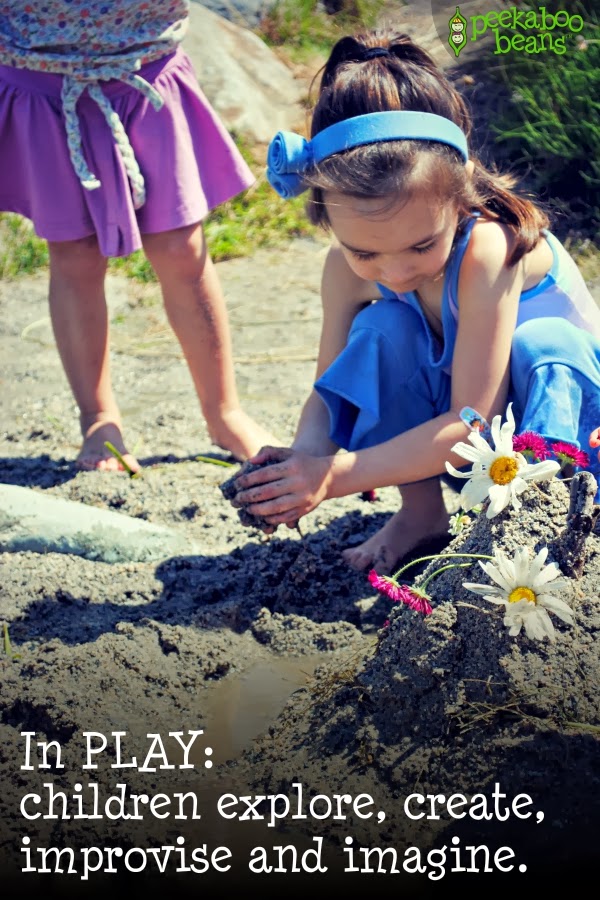
Beans is on a mission to rescue children of today from a play deficit and help bring daily unstructured play back into their lives. A way we can help do this is by raising awareness of the importance of play and encourage parents to get their Beans playing outdoors and having fun. Children need this
free time and free play in order to grow into happy healthy human beans! Play is not a
option, it's a necessity!
So, we encourage you to join this months 31 Day PLAY
Challenge with your family and embrace the opportunity to
experience some creative outdoor activities and fun adventures during this last
month of the Spring season. Peekaboo Beans 31 Day PLAY
Challenge is here to help bring fun back into your life and
connect with your children through sharing time together, having fun with one
another and PLAYING! And with this new PLAY challenge we are encouraging the use of reusable & eco friendly items found around the home... since doesn't need to be FANCY to be EFFECTIVE!!